
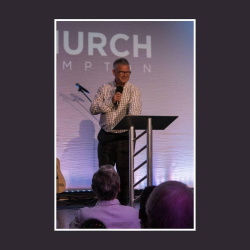
This is what you must do: respond well to tough treatment even when you’re in the right.

There’s nothing quite like injustice to make us angry. Working for a harsh manager can become unbearable and we must not keep silent on certain issues. How does a Christian respond when they know absolutely they are in the right and their manager is in the wrong?

We are moving further into this code of conduct that Peter is writing. We get to the work place. To something that is hard for us to get our minds around: slavery.

Slavery seems to have been universal at this time. There are estimates of up to 60 million slaves in the Roman Empire. Many were well-treated but many were equally abused. They included not only domestic slaves and manual labourers but educated people as well. The problem Peter was addressing was that it seemed that some Christian slaves were believing that if God made them free then it meant they could run away from their masters and Peter says ‘no you can’t do that.’

“Slaves, in reverent fear of God submit yourselves to your masters, not only to those who are good and considerate, but also to those who are harsh. For it is commendable if someone bears up under the pain of unjust suffering because they are conscious of God. But how is it to your credit if you receive a beating for doing wrong and endure it? But if you suffer for doing good and you endure it, this is commendable before God. To this you were called, because Christ suffered for you, leaving you an example, that you should follow in his steps.” (1 Peter 2 v 18-21)

Though this is difficult to read because we all believe slavery is abhorrent it does have teaching that we need to apply to our lives, especially in serving/working for people in authority over us:-

  1. If you are a bad employee and the consequence is punishment then you deserve it and God is not glorified in your life.
  2. If you recognise that you are actually serving God and not man then if your work becomes difficult because you are unjustly treated then this is a God matter.
  3. The outworking of revering God is the ability to submit to difficult managers. When others see Christians doing this they are likely to wonder where do they get the strength to do so?
  4. We will adopt this submissive attitude because our model is Jesus Christ and our lives will point to what He has done for all. He suffered sinful treatment to atone for sin.
  5. To walk in the steps of Jesus is to respond well to tough treatment even when you’re in the right.

This is what you must do: Have the right attitude in life.

I read an email this week forwarded to me from one person to another. It was vile and vitriolic and I wondered how the person was who it was addressed to.

I was shocked that this was not from some juvenile delinquent but a respected member of their community.

I was even more shocked that it was from a Christian leader within the Church addressed to their own Christian leader.

Clearly they need to go back to the classroom to learn how to hold the right attitude.

It is hard to understand a list of conduct dated over 2,000 years ago. We are in 2023 how can it be still for us today? I think we are helped knowing that life for the Christian in Peter’s day was significantly more difficult than for us in this Western world of ours.

“For it is God’s will that by doing good you should silence the ignorant talk of foolish people. Live as free people, but do not use your freedom as a cover-up for evil; live as God’s slaves. Show proper respect to everyone, love the family of believers, fear God, honour the emperor. (1 Peter 2 v 15-17)

Here are the 6 attitudes:

  1. Do good – even when you are criticised.
  2. Live as free – but still pay your taxes and obey the law.
  3. Show respect – on all people not just the nice ones.
  4. Love the Church – they are God’s family, they belong to Him.
  5. Fear God – walk under His gaze even when you write an email.
  6. Honour the ruler – emperor, king, government, even if they kill Christians as Peter’s emperor did, for it is the office you honour not necessarily the ruler.

Today choose the right attitude to live.

This is what you must do: don’t fight but submit

These people lived under the Roman oppressive regime which was particularly difficult as a follower of Jesus. This was not a democratic society nor was it a godly one either. It would be very easy to copy the Jewish thought and not obey a non-Jewish leader but Peter tells them that it doesn’t matter who they are they should obey. (The qualifier is always Acts 4:19 where we never submit to something if it means we are disobedient to God.)

Like Paul, Peter has a household code which covers all the social settings at the time. In each one he is basically saying ‘don’t fight but submit.’ Living under authorities; slaves and masters; wives towards husbands; husbands towards wives and everyone in the Christian community. That’s what is ahead of us in this letter. But for now …

“Submit yourselves for the Lord’s sake to every human authority: whether to the emperor, as the supreme authority, or to governors, who are sent by him to punish those who do wrong and to commend those who do right.” (1 Peter 2 v 13-14)

Who do we submit to?

‘To every human authority’. Every human authority. Human authority. Every.

Whether you like them or not.

Whether you recognise them or not.

Whether you voted for them or not.

The highest authority to the lowest who carry out the orders.

Why?

  1. For the Lord’s sake. It doesn’t matter whether you agree or disagree God has ordered authority within society.
  2. They are sent by him. God has sent them into society, whether you would have sent them or not. If Peter believed the Roman Emperor was sent by God then we can believe ‘every human authority’ is sent by God too.
  3. The purpose of order. So that the wrong is punished and the right is rewarded.

If this is how it is with the Roman Empire and with our governments today; if this is for every human authority in our social settings so in education, social services, healthcare etc. Then it is also for the Church. It applies to the church. Don’t fight but submit.

This is what you must do: be beautiful.

Beautiful without make-up and a face-lift.

Beautiful without super-white teeth and hair replacements.

Beautiful without Nike, Louis Vuitton and Hermes.

Live beautifully, act beautifully.

“Live such good lives among the pagans that, though they accuse you of doing wrong, they may see your good deeds and glorify God on the day he visits us.” (1 Peter 2 v 12)

Peter uses the word ‘good’ but it seems rather weak though the translation from ‘kalos’ is its meaning.

However it means this, ‘beautiful, good, excellent in its nature, genuine, honourable’ and it also means, ‘handsome, admirable, beautiful to look at’.

Ever met an ugly Christian?

It has nothing to do with how they look. But how they speak, how they respond and their decisive actions in the world they live.

In Peter’s generation the followers of Jesus would be accused of many things. For example the word, ‘atheists’ was first used for the Christians because they would not worship idols. In our world we still struggle with wanting to fit into the neighbourhood and work place and yet not compromise on our behaviour. Peter says in this difficult world of ours, be beautiful.

Can people see the beauty of Jesus in you? Can they hear the words of Jesus from your lips? Can they see the servanthood of Jesus in your actions?

This is the meaning of kalos. It is kalos that will lead them to become Christians themselves and not face judgment but His glory.

Be beautiful today. On social media be real but be beautiful. Let your world see you and give glory to God.

This is what you must do: watch your ego.

Having reminded these suffering believers of who they were Peter now tells them what they must do.

The temptation in the midst of suffering is to withdraw, to hide away and become a hermit. Peter gives instructions so that his friends (and that’s what they are to him) do not do this.

Dear friends, I urge you, as foreigners and exiles, to abstain from sinful desires, which wage war against your soul.” (1 Peter 2 v 11)

There is a war that is hidden yet is more destructive than any disease or attack on your body. It is the war against the soul, the inner man.

I recently sat with a man who for decades of his life had battled this inner war. This onslaught will not stop until it has taken everything. The man has lost his testimony, his trophies of success, his family, he is a shell of what he was and yet the war will continue until every ounce of life is taken.

‘Sinful desires’ are the grasping, reaching, longing, chasing after false dreams, deceptive satisfaction, poisonous fruit, which doesn’t give us to us what we hoped for but rather in turn attacks us with a vengeance in order to steal, kill and destroy our lives. And before we begin to itemise these sinful desires in order to thank God we do not commit them, it is not that simple. The Message helps us to understand by saying, ‘Don’t indulge your ego.’ How and why do people behind pulpits and on pedestals fall? The answer is found within the ego. “I deserve this, I need this, I am justified to do this, I have to have this, this will benefit not just me but the whole, I need to step into a moment of fantasy, I need to hide in another world, I must find happiness, excitement, I need more ‘drugs’, I need a higher high.’ Ego.

This is why Peter tells us that we do not belong here. We pass through. We are foreigners, strangers, exiles, sojourners. There is nothing you need that will be found in this world. The answer is of course Jesus.

How is your soul today? What do you think you deserve?

Are you in this war that Peter describes? The man I spoke with had countless opportunities to tell a close friend, to get help, but his ego prevented him. His ego trapped him. His ego stole all that he was.

Watch your ego. Kill it before it kills you.

This is who you are

Some days we need to be reminded of who we are as Christians. In fact much pain in the world is exactly that: who am I? In our lifetime we have begun to use words to describe people in ways our previous generation never envisaged: ‘them’; ‘non-binary’; asking the question who am I has never been more important.

Coming aside from gender identity and the changing of our bodies to fit who we think we really are: what does God think of you today? Who does God say you are beyond your identity because whatever we change about our bodies our soul is the same. Only God can do surgery on our soul.

Drawing from what God said to the Israelites at Mount Sinai, from the prophet Isaiah and also the story of Gomer found in the prophet Hosea.

Basically Peter says this, ‘No matter what is going on for you, no matter how difficult your life is right now, all of what God said to His people back then is true for you who believe and follow Jesus.’ Isn’t that amazing?!

“But you are a chosen people, a royal priesthood, a holy nation, God’s special possession, that you may declare the praises of him who called you out of darkness into his wonderful light. Once you were not a people, but now you are the people of God; once you had not received mercy, but now you have received mercy.” (1 Peter 2 v 9-10)

So let’s unpack that a bit with encouragement for you:

  1. He hasn’t made a mistake with your life. You are a chosen people.
  2. He has called you to reign with Him as the King. You are a royal priesthood.
  3. He has set you aside to think, speak and act differently to the world you live in. A holy nation.
  4. You belong … to Him! God’s special possession.
  5. You are called … to Him! Called out of darkness into his wonderful light.
  6. You have an identity … in Him! People of God.
  7. You have mercy for your undeserved restoration and transformation. Have received mercy.

The Rock of Offence

The work of Christ was that the building upon Him as the cornerstone would be a house of worship for both Jew and Gentile.

However as we are fully aware the Jews didn’t want to share the house with the Gentiles. They either wanted Judaism to have a face-lift or definitely 2 houses built. There was no appetite for union. There still isn’t.

But these Old Testament prophecies which Peter quotes from are for both Gentile and Jew.

So the cornerstone which is the foundation for life becomes the falling stone which crushes the future because of offence.

“Now to you who believe, this stone is precious. But to those who do not believe, “The stone the builders rejected has become the cornerstone,” and, “A stone that causes people to stumble and a rock that makes them fall.” They stumble because they disobey the message—which is also what they were destined for.” (1 Peter 2 v 7-8)

If this letter was written between AD62-64 then within 8 years the Romans had entered the city of Jerusalem, flattened it and then led the religious leaders bound in chains into foreign nations. They came under God’s judgment. The stone had fallen on them just as Jesus had also said (Matthew 21)

It is far better to make Jesus the cornerstone of your life. There is a key place in all our lives.

Is Jesus occupying the place of huge importance? Is he in the decision making part? If he is not Lord then you may stumble over him and worst still you may be crushed by Him.

Be careful what you become offended by.

To those who are under a weight of pressure: God will vindicate you

It is widely believed that Peter wrote this letter during Nero’s reign and around AD 62-64. It is written to the scattered Christians in modern-day Turkey who live under the Roman Emperor’s control. It is full of encouragement to persevere under the intense pressure of persecution. They are to remain faithful to Christ and walk in His example. Peter will quote from the Old Testament to support what he writes, as he does in these verses, from Isaiah 28, Psalm 118 and Isaiah 8 respectively.

“As you come to him, the living Stone—rejected by humans but chosen by God and precious to him— you also, like living stones, are being built into a spiritual house to be a holy priesthood, offering spiritual sacrifices acceptable to God through Jesus Christ. For in Scripture it says: “See, I lay a stone in Zion, a chosen and precious cornerstone, and the one who trusts in him will never be put to shame. Now to you who believe, this stone is precious. But to those who do not believe, “The stone the builders rejected has become the cornerstone,” and, “A stone that causes people to stumble and a rock that makes them fall.” They stumble because they disobey the message—which is also what they were destined for.” (1 Peter 2 v 4-8)

Perhaps today you feel stuck between a rock and a hard place!

Are you anxious of what might happen to you? Don’t be!

God will vindicate you:-

  1. As God laid a stone in Zion, He has also sent and established you in this place. You are where you are because of God.
  2. God chose His Son. He doesn’t make mistakes and that includes you.
  3. God placed Jesus as the cornerstone. Though the mounting pressure on you may feel all-consuming it is not the most important thing in your life. The cornerstone sets the course of action. He has you.
  4. God gave you someone precious. Jesus is a treasure of love, grace, truth, peace and power. You trust Him, you love Him, you belong to Him; He is precious to you.
  5. God was glorified during the rejection, slander and persecution of His Son because Jesus was obedient and held onto His Father. In the same way there is no shame or humiliation to those who put their hope in Jesus. Remember you are standing on the Rock.

The Living Stone and the living stones.

I was privileged when I was a Pastor to have had 3 buildings; a converted cow-shed; then a smaller church building which was originally a Unitarian Church and then a very large Methodist Chapel built in 1839 which we renovated. I loved the cow-shed as much as the Chapel. But I knew that they were just stones. It was the people within the buildings that made them come alive.

To a people who know suffering and the difficulty of remaining as a follower of Jesus because of hardship and persecution, Peter writes this:-

“As you come to him, the living Stone—rejected by humans but chosen by God and precious to him—you also, like living stones, are being built into a spiritual house to be a holy priesthood, offering spiritual sacrifices acceptable to God through Jesus Christ.” (1 Peter 2 v 4-5)

Jesus is the foundation, the living Stone, the capstone, chief cornerstone, however you want to word it. He was rejected and he suffered even though he was chosen and precious to God.

What is Peter trying to say?

It may be tough but it was also tough for the very foundation of your life, Jesus.

It does not mean you have not been chosen by God.

It does not mean you are not precious to Him.

In fact following Jesus means that it is possible that everything around you will value you far less than God does.

Because ‘you also’ … this is what it means to follow Christ.

As I look back on those 3 buildings I reflect on the people who formed the spiritual house of those places. I can hear the joy; I can see the worship; it is so easy to be right there in the centre again of all that was being experienced as lives were being transformed, salvations, baptisms, healings as the manifest presence of God came upon His people. As the Pastor for these people I can also easily remember the pain, the tears, the suffering that these people also had in their lives, the difficulty to keep on following Jesus in the context of their world.

Yet though they are scattered all over the UK and the world, in Europe, Africa, Asia and USA, I know in those buildings these people were becoming more like Jesus in their suffering and through it all they were being built into a spiritual house, more than just a community, they were a temple. They had become living stones built upon the Living Stone.

How to thrive in adversity: crave!

So I am a proud ‘pappa’. My granddaughter has now just been weighed again and has reached the grand total of 16ibs 8.5oz!! A marvellous achievement!

Over these last several months she has put on weight! Just like her pappa!

How did she achieve this grand accomplishment?

Milk!

Having spent a wonderful week with her and the family recently I was reminded of the demands her bundle of loveliness brings and it is all around her cravings for milk.

Apostle Peter in writes to the Christians who are suffering. This is an encouraging letter to hold on, keep going and not to let go of their faith.

“Like newborn babies, crave pure spiritual milk, so that by it you may grow up in your salvation, now that you have tasted that the Lord is good.” (1 Peter 2 v 2-3)

Paul uses the idea of newborn babies craving for the immaturity of believers.

However Peter uses it to show the passion and desire to grow through the suffering.

He particular chooses Psalm 34 not because it has the ‘taste that the Lord is good’ verse but because of the entire message of the Psalm itself.

The context is suffering and the message of the Psalm is God is close and they will thrive in their adversity. Peter is saying the people of this Psalm were going through what is taking place in your life also.

I will glory in the Lord; let the afflicted hear and rejoice… I sought the Lord, and he answered me; he delivered me from all my fears… This poor man called, and the Lord heard him; he saved him out of all his troubles. The angel of the Lord encamps around those who fear him, and he delivers them… Taste and see that the Lord is good; blessed is the one who takes refuge in him10 The lions may grow weak and hungry, but those who seek the Lord lack no good thing. 15 The eyes of the Lord are on the righteous,     and his ears are attentive to their cry; …17 The righteous cry out, and the Lord hears them; he delivers them from all their troubles… 18 The Lord is close to the brokenhearted … and saves those who are crushed in spirit… 22 The Lord will rescue his servants; no one who takes refuge in him will be condemned.

The readers of Peter’s letter knew this Psalm and he used it again later.

He is telling them how to thrive in adversity.

How?

Crave!