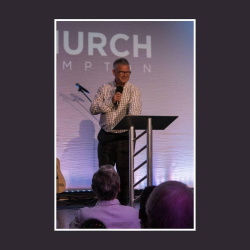
The powerful gospel in its simplest form.

Having told Timothy to pray for kings and all those in authority, including Nero, he now declares (if it is at all needed) who is above all these titles.

“For there is one God and one mediator between God and mankind, the man Christ Jesus, who gave himself as a ransom for all people. This has now been witnessed to at the proper time. And for this purpose I was appointed a herald and an apostle—I am telling the truth, I am not lying—and a true and faithful teacher of the Gentiles.” (1 Tim 2 v 5-7)

There is one God. We are reminded of the great Shema of Deuteronomy 6 declaring monotheism over polytheism.

There is one mediator. The man Christ Jesus who became the bridge between God and mankind.

There is one ransom. The price paid to release slaves and prisoners.

There is one proper time. As part of God’s eternal plan, the incarnation, death and resurrection didn’t happen randomly but with perfect timing.

There is one purpose. That is for all to be saved. Not just the Jews but the Gentiles also.

In these 3 verses Paul gives a complete theology of salvation. God desires all to be saved, through a Saviour who gave His all, to make that possible and a mission that continues to go to every part of this world.

Where is the herald? The one who proclaims the gospel to those close and far.

Where is the apostle? Who is sent.

Where is the teacher? Who instructs and explains the gospel.

Where? Right here, the one writing and the one reading this devotion today!

Who’s your Nero?

Nero, the Roman Emperor reigned during the time of Paul. He was known for his wickedness especially his persecution of Christians. Nero was feared. Nero certainly wasn’t liked by the Christians. Nero was the Pharaoh of the Old Testament.

“I urge, then, first of all, that petitions, prayers, intercession and thanksgiving be made for all people— for kings and all those in authority, that we may live peaceful and quiet lives in all godliness and holiness. This is good, and pleases God our Savior, who wants all people to be saved and to come to a knowledge of the truth.” (1 Timothy 2 v 1-4)

Who don’t you like? Maybe you cannot even say their name. Who has authority over you and who makes your life difficult?

Who’s your Nero?

Paul challenges Timothy to bring requests to God, four focused prayers, these are not casual grunts, petitions, prayers, intercession and thanksgivings, who for? For all people. Including your Nero!

This is so counter cultural.

It doesn’t mean we are praying for their successes in their policies nor especially their wicked behaviour or injustices.

It does mean we pray so that we can continue in our discipleship. To live peacefully, quietly and with godliness and holiness.

The fact is that God wants our Nero’s saved. Regardless of their position, politics or however they have impacted your life, hurt you or stood against you, God wants to reach them with His love.

  • Pray regularly for your leaders, good ones and bad ones, even those that hurt you.
  • Pray for the advance of the gospel.
  • Give thanks even in tough times.

Above all remember that one of the great benefits of prayer is that it doesn’t just change circumstances  – it changes us.

Church Discipline

We are going to read some of the most sobering words in the whole of Paul’s letter to Timothy. As leaders we must read it carefully. It reveals the weight of leadership responsibility; the necessity of difficult decisions; and the ultimate goal of restoration.

 “Among them are Hymenaeus and Alexander, whom I have handed over to Satan to be taught not to blaspheme.” (1 Timothy 1 v 20)

Among who? The previous verses tells us, “have suffered shipwreck with regard to the faith.”

This doesn’t give us the right to be harsh or quick to discipline. This isn’t about excommunicating people who don’t agree with the leadership. This verse in the hands of the abusive leader can be very dangerous.

We don’t know who these 2 people are. Paul says in v19 that some have not held on to the faith nor a good conscience and describes it like a shipwreck. Their end was the opposite of how they thought it would be when they started out in the faith. These were people from within the Church. They were well-known. Maybe they were leaders themselves. They were guilty of blaspheming, of bringing shame to Christ’s name and Paul handed them over to Satan. Paul used this phrase in 1 Corinthians 5:5 in the context of sexual immorality. So for Paul this handing over to Satan was not to do so physically but to separate the individual from the Church community for a time in order to restore them.

Sometimes love requires difficult decisions. The goal is always restoration. It is always redemption. Leadership isn’t to avoid difficult situations but rather to navigate them with wisdom and courage.

Leaders carry a weight of responsibility for people they love and serve. Sometimes the very people they have invested in and worked alongside make choices that harm the mission, the organization, the community.

Leaders have to make difficult decisions. Here is the most severest decision to make regarding discipline. This wasn’t done in anger or revenge but it is the last resort, the last hope that the person can be restored. The removal of the individual that they might come back restored. These decisions are emotional and draining. Where the many may want to avoid confrontation the leader has to step in with courage and wade through the hurt and pain from all sides.

Leaders are restorers. Motivation is everything. Paul wasn’t trying to destroy these 2 men. He was creating conditions where they might come to their senses and return to the truth.

Ask any leader about Church discipline and they will say it is needed but it is difficult. The removal to restore is perhaps one of the most painful of moments for the one who has brought shame to Christ but also to the leader who loves that individual. But without Church discipline what would we have?

5 things to do with your personal prophecies.

You may have a Bible where you underlined that important verse which spoke to you all those years ago. You may have a plaque on the wall or a fridge magnet where the quotation is a voice in your house. You may have a journal with that prophetic word given to you in a church service was written down in excited enthusiasm.

Paul is wanting Timothy to remember what God had spoken to him about in order to be encouraged to stay in Ephesus.

“Timothy, my son, I am giving you this command in keeping with the prophecies once made about you, so that by recalling them you may fight the battle well, 19 holding on to faith and a good conscience, which some have rejected and so have suffered shipwreck with regard to the faith.” (1 Timothy 1 v 18-19)

So what should you do with the personal prophecies you receive?
From these two verses we can see we should:

1. Remember them.
2. Tell someone else about them and ask them to remember too.
3. Follow them, aligning your life with them.
4. Be inspired by them and helped in life by them.
5. Let them cause you to hold on despite your struggles.

Stability when your world shakes

It may seem strange to have a doxology when this pastoral and leadership letter to Timothy is far from over. But Paul has just finished recounting how he went from being a “blasphemer and a persecutor and a violent man” (v13) to become an apostle of Jesus Christ. When you have been overwhelmed with grace and mercy then spontaneous doxologies burst from your mouth as they do here!

“Now to the King eternal, immortal, invisible, the only God, be honour and glory for ever and ever. Amen.” (1 Timothy 1 v 17)

There is no beginning and no end to God’s kingdom. Beyond time itself, beyond your difficult day or season or even the whole of your life stands an eternal King who is sovereignly working all things out for His purpose.

There is no death or decay with God. Every part of creation is mortal but God remains unchanging and indestructible. His love for us will never fade; His promises will always remain and He is totally reliable on every occasion.

There is no limitation to God. We cannot reduce Him through our human perception. He is not bound by physical barriers but He is omnipresent. He makes Himself known in the most unlikeliest of places.

There is no other like Him. He is the only God. The world has competing gods and ideologies. But there is only one true God who deserves all the worship.

Your world may have changed overnight. News has come and life now seems uncertain. This doxology is the anchor for your soul.

It gives you a corrected perspective in the midst of trial. Our struggles are temporary but He is eternal.

It protects you from pride. You may be feeling victorious today but every victory and achievement has come because the only true God helped you.

It guides how you spend your life. You begin to think eternally when you worship and eternal God.

Paul ends with an AMEN. LET IT BE SO.

Can you say AMEN today?

The Leadership Example

Leaders often feel the pressure to be someone strong, to have everything worked out, competent, smiling all the time and 100% holy in everything they think, speak and do. Every leader knows this is not only a false image but totally unlivable.

Paul’s leadership letter to Timothy is this: You need grace as much as anyone so live like that – and in doing so you will create the space for others to find hope in their journey too.

“Christ Jesus came into the world to save sinners—of whom I am the worst. 16 But for that very reason I was shown mercy so that in me, the worst of sinners, Christ Jesus might display his immense patience as an example for those who would believe in him and receive eternal life.” (1 Timothy 1 v 15-16)

So what is this leadership example?

Paul had a testimony. This testimony became his most powerful leadership tool. When he speaks of God’s mercy, this is not some theology, this is a lived-out experience. Those who are able to articulate their own personal struggles and need of God’s mercy build bridges to those they lead.

Paul has needed patience. Not for others but for himself from Christ. Jesus Christ has worked with a flawed Paul and in the end produced transformation. In the same way the leader expresses patience to those who have made mistakes, recognising that character development takes time and understanding that you too haven’t arrived.

Paul leaves a legacy. Paul is cultivating future leadership by showing God can use anyone – even the worst of sinners. Instead of looking at the shortcomings, the sin and what is wrong with the person, can you see their leadership potential? The next leader could come from an unexpected place.

This is the leadership example from these 2 sentences of Paul.

I’m a leader but that doesn’t mean I’m powerful.

Paul’s leadership letter to his son in the faith, Timothy, is life-changing or could be if leaders heard and walked it out. 

Leadership does not create a culture of suspicion, scepticism or a desire to scrutinise if it was possible to get near that leader to do so. It doesn’t manipulate, build fear and uncertainty, is not unpredictable, it does not boast, does not need titles, is not demanding of respect and if all I am mentioning equals power, then leadership, certainly godly leadership, is not power. 

“Here is a trustworthy saying that deserves full acceptance: Christ Jesus came into the world to save sinners – of whom I am the worst.” 1 Timothy 1:15

Paul uses this phrase, “Here is a trustworthy saying that deserves full acceptance” 5 times in his letters. So it’s important!!

Leadership is not about power but it is about self-awareness.

We live in a world when leaders hide the truth of who they are. Paul didn’t. He was the worst of sinners. This was not great publicity and effective social branding. Who would want to follow this leader? 

Yet Paul shows us that true leadership strength emerges not from projecting perfection, but from understanding and acknowledging their own flaws and failures. When this happens they create space for growth—both in themselves and in those they lead.

The big question good leaders keep asking is this: how do people perceive me? And they ask trusted people for the answer instead of what they see when they glance into the mirror of their good sermons and growth of their ministry. That fruit is not the key performance indicator on how well they are doing as a leader. Self-awareness is. Power is nothing compared to this.

What is the bedrock of leadership?

I am trying to view this letter through the filter of leadership because it is a private letter to Timothy, a leader and a son in the faith for Paul. There are more leaders than we realise, not only those behind pulpits, but parents, grandparents and in every sector. Even if you think you’re not a leader then these lessons are still for your Christian discipleship.

These next few verses are powerful because they reveal the foundation for good leadership from an honest appraisal of Paul’s own life. Every thought, word, response and action reveal what is underneath and what no one can see, the bedrock.

 “I thank Christ Jesus our Lord, who has given me strength, that he considered me trustworthy, appointing me to his service. 13 Even though I was once a blasphemer and a persecutor and a violent man, I was shown mercy because I acted in ignorance and unbelief. 14 The grace of our Lord was poured out on me abundantly, along with the faith and love that are in Christ Jesus.” (1 Timothy 1 v 12-14)

If this bedrock is not there then eventually the building will collapse. So what is it?

  • Gratefulness.

    The position of any leader and any Christian has not come about because of some mere achievement. Paul acknowledges who is his bedrock – Jesus Christ. It is a privilege and a responsibility to serve as a leader. When there is zero entitlement and simply total gratitude then it completely changes the leader’s perspective on what they have become, what they do, how they speak and respond. It is chalk and cheese. Entitlement will turn your stomach when you see it but gratitude will draw you closer to the leader. The reason being is that gratitude lays a pathway where everyone is valued not used.

    • Reliance.

    No one has all the answers. A leader should be able to be heard to say, ‘I don’t know’. Pride destroys many leaders and the key is to know there your reliance is. Paul says Christ Jesus has given him strength.

    • Trust.

    Paul says Christ Jesus considered him trustworthy. Character matters more than credentials. There is no gifting that outweighs trust. It is built through integrity, consistency and reliability. It takes a long time to build and it can come falling down in a moment of madness.

    • Vulnerability.

    Paul was honest about his past. He doesn’t re-write history. He doesn’t hide his mistakes. This isn’t about making yourself the centre of everyone’s titillating interest but it helps to show you are human and have failed in the past. The problem comes when a person never sees they’ve made a mistake.

    • Grace and Mercy.

    Paul says he was shown mercy and grace was poured out on him. He became a strong influential leader because he experienced the God of second chances. These form the bedrock of our lives. Without them we will struggle to be the leader God calls us to be.

    Every leader … needs a mirror, safe spaces, grace, trust and sound doctrine in their lives.

    Leaders need to believe not only in the gospel but also conviction and self-awareness.

    In these next few verses Paul is speaking of the Old Testament Law. The law pointed to Christ and Christ fulfilled the law. Christians are saved because of the gospel of Jesus Christ but we still need the motivation and the heart of the law. Why?

    “ We know that the law is good if one uses it properly. We also know that the law is made not for the righteous but for lawbreakers and rebels, the ungodly and sinful, the unholy and irreligious, for those who kill their fathers or mothers, for murderers, 10 for the sexually immoral, for those practicing homosexuality, for slave traders and liars and perjurers—and for whatever else is contrary to the sound doctrine 11 that conforms to the gospel concerning the glory of the blessed God, which he entrusted to me.” (1 Timothy 1 v 8-11)

    • Every leader needs a mirror.

    We need to know we fall short of God’s standard. We need a mirror that declares a self-awareness. We need to be able to examine our own hearts. We need conviction. The list isn’t to condemn, if it was, we need a bigger list. It is helping us to understand that we need the gospel of grace and we need constant transformation.

    • Every leader needs to be able to create safe spaces.

    Structures, standards, policies, ‘lists’ are not for restriction but protection of individuals within community. For people to flourish they need the safe places where there is no fear of manipulation or harm.

    • Every leader needs to lead with more grace rather than rules alone.

    The gospel is the transformative power that changes hearts and lives. The rules reveal the problem but it is the grace of this gospel that brings the solution. You can usually see grace and you can definitely see the effect where there are only rules. Leaders who operate without grace and only use the rules often find themselves needing grace but only being given the rules. We reap what we sow.

    • Every leader has been given a sacred trust.

    Paul notes that the gospel of grace was entrusted to him. We need to handle our position carefully and that means to be good stewards of the gospel not only in the pulpits but shepherding those in the pews.

    • Every leader must hold to sound doctrine.

    There needs to be a standard that can be measured. This means Biblical truth not cultural trends or some soap-box opinion. So we need Truth. In what is preached and what is lived.

    Paul’s instruction to the leader Timothy applies today.

    Stay and stand.

    How can we create environments where people flourish? How can we lead when people around us make it difficult at times? Stay and stand.

    In these next few verses I offer 3 leadership lessons to those who are currently appointed into a position of leadership and have to make a stand for what they have been called to.

    “As I urged you when I went into Macedonia, stay there in Ephesus so that you may command certain people not to teach false doctrines any longer or to devote themselves to myths and endless genealogies. Such things promote controversial speculations rather than advancing God’s work—which is by faith. The goal of this command is love, which comes from a pure heart and a good conscience and a sincere faith. Some have departed from these and have turned to meaningless talk. They want to be teachers of the law, but they do not know what they are talking about or what they so confidently affirm.” (1 Timothy 1 v 3-7)

    • Protect from drift.

      There are certain people, not everyone, but some, who may have a loud voice, they may be influential, so they think, who want to dilute or distract others from your core message. Whether that be the gospel or your church vision and strategy, these people want to cause a drifting away from all you have invested in. They may not know they are doing it and others may be blinded by their passion but it is endangering a derailing of all you believe. Your role is to stay and protect against this. Keep the alignment of your church and ministry intact.

      • Don’t waste time.

      There isn’t anything wrong with debate and theorising but strategic discussion and planning is better. There isn’t anything wrong with criticism but when it destroys it becomes the antithesis of constructive feedback. There isn’t anything wrong with confidence but it can hide incompetence. If a leader refuses to permit being challenged because they are always right, then they are definitely wrong. Your role is to stay and make sure you build a culture of life-giving authority.

      • Character, character, character.

      We have heard all our lives that character is more important than gifting and all of our life we see gifting being discussed, promoted and celebrated more than character. But it is character that will bring everything crashing to the floor or keep everything steady and sure. Your role is to stay and lead with a pure heart. Your motivations matter. Ask this question. Why? It is the best question to ask yourself. Stay and lead with a good conscience. This will bring the confidence and authenticity that is needed. Stay and lead with a sincere faith. Your deep conviction creates genuine leadership influence.

      Sometimes the most courageous thing a leader can do is to stay and speak truth in love because what you allow to grow will either cause drift, waste your time or weaken your character instead of advancing the work God has called you to.