
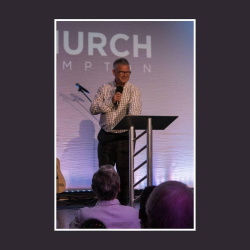
It is never too late

It is never too late

Mark 10: 46-47 “Then they came to Jericho. As Jesus and his disciples, together with a large crowd, were leaving the city, a blind man, Bartimaeus (which means “son of Timaeus”), was sitting by the roadside begging. 47 When he heard that it was Jesus of Nazareth, he began to shout,

You are never too late, v 46

Jesus was passing through Jericho but it wasn’t too late for Zacchaeus (Luke 19)

Jesus took the disciples to a solitary place by boat “But many who saw them leaving recognized them and ran on foot from all the towns and got there ahead of them.” Mark 6:33

And here in this story we see Jesus was leaving Jericho but Bartimaeus thought “It’s not too late for me”

Blindness was a serious disease at the time of Jesus. Society looked at it like it was one step up from death! There was no example in the Old Testament of a cure.

But every Jew knew that the promised messianic age would bring healing to the blind, for example,

Isaiah 35:5 “Then will the eyes of the blind be opened and the ears of the deaf unstopped”.

The only hope and dream for Bartimaeus was that the Messiah would come in his lifetime. There were many days spent in discouragement holding on to a dream.

It’s never too late to become determined again. It’s never too late to shout out to God.

You may have experienced failure, you may have been overwhelmed with discouragement and you may have quit from everything in your life, but TODAY you can receive His touch on your life and rise in a new level of determination. When you think it’s all over God comes in and says we haven’t begun yet, I am about to light the fire of passion in your life.

God came to Jonah and brought understanding to his situation.

He came to Moses and challenged him with the question: ‘Is the LORD’S arm too short?’ meaning ‘Watch this space’

He came to Elijah and called him out of the cave and into the place of the still small voice of God and brought balance to his life.

It’s never too late.

I remember singing in my youth a song that still moves my heart today:

Is there a heart that is waiting,
Longing for pardon today?
Hear the glad message proclaiming,
Jesus is passing this way.

Refrain
Jesus is passing this way,
This way, today;
Jesus is passing this way,
Is passing this way today.

Is there a heart that has wandered?
Come with thy burden today;
Mercy is tenderly pleading,
Jesus is passing this way. [Refrain]

Is there a heart that is broken?
Weary and sighing for rest?
Come to the arms of the Saviour,
Pillow thy head on His breast. [Refrain]

Come to thy only Redeemer,
Come to His infinite love;
Come to the gate that is leading
Homeward to mansions above. [Refrain]

The amazing thing is that it was written by a blind woman, Fanny Crosby.

“I think it is a great pity that the Master did not give you sight when he showered so many other gifts upon you,” remarked one well-meaning preacher. Fanny Crosby responded at once, as she had heard such comments before. “Do you know that if at birth I had been able to make one petition, it would have been that I was born blind?” said the poet, who had been able to see only for her first six weeks of life. “Because when I get to heaven, the first face that shall ever gladden my sight will be that of my Saviour.”

One day you will meet Christ face to face and I think we all will say:

“Jesus thank you for enduring so much. Thank you for being so determined to go to the place of passion, the place of suffering, the cross. Because you remained in that place, you purchased my freedom, my sins were forgiven, my life transformed, you changed my world and guaranteed my eternity.”

For now, Jesus is passing this way, today and it is never too late to shout out. Whatever your situation, no matter what has happened or has gone wrong, no matter how old or experienced you are, call on him, it is never too late, call upon Him now whilst you can, He is your continual Saviour!

Find a way find the Way.

Find a way find the Way.

Mark 10: 46-52 “Then they came to Jericho. As Jesus and his disciples, together with a large crowd, were leaving the city, a blind man, Bartimaeus (which means “son of Timaeus”), was sitting by the roadside begging. 47 When he heard that it was Jesus of Nazareth, he began to shout, “Jesus, Son of David, have mercy on me!” 48 Many rebuked him and told him to be quiet, but he shouted all the more, “Son of David, have mercy on me!”49 Jesus stopped and said, “Call him.” So they called to the blind man, “Cheer up! On your feet! He’s calling you.” 50 Throwing his cloak aside, he jumped to his feet and came to Jesus.51 “What do you want me to do for you?” Jesus asked him. The blind man said, “Rabbi, I want to see.” 52 “Go,” said Jesus, “your faith has healed you.” Immediately he received his sight and followed Jesus along the road.”

Find a way find the Way.

Jesus was travelling with his disciples and a large crowd in tow. They have passed by a man who has not until that day found a way to deal with the major issues of his life.

We all have something that needs to be overcome and in some cases it may well remain with us all our life. For us it is a stigma, it is a distinguishing mark of social disgrace, even if others don’t think so.

“I’m not married and I want to be. I’m in a job and I can’t get out of it. I don’t have a job and I want one. There is someone who hates me but I wish they were my friend. I have a physical handicap and I can’t believe it’s here to stay. I worry about my sexuality, am I normal? I’m a sick person who worships God the healer. I’m a blind man a beggar who sits on the side of the road.”

God is calling us to overcome whatever challenges lay in front of us so that we can expect His favour. He has called us to live by faith and not by sight.

Does your expectation serve your challenge or does your challenge submit to your expectation? You must never allow your challenge to set your pace and plot your course.

Something would happen to this blind man on this day, he had come to know that Jesus of Nazareth was the Son of David, the Messiah, the healer, the Anointed One.

A fresh revelation of who Jesus is leads to you finding a new way in your life.

Is Jesus known as Jesus Christ of Bethlehem? Jesus Christ of Jerusalem? Neither: He is Jesus Christ of Nazareth. Nazareth, the place where Nathanael would say, ‘Can anything good come out of Nazareth?’ But it was to Nazareth, a remote tiny Galilean town that angel Gabriel came to a young virgin girl named Mary. To Nazareth, a town so insignificant it wasn’t even included on the census lists of that time. It was here where Gabriel announces: “Greetings, Mary, you who are highly favoured!” Mary of Nazareth was chosen for a unique role.

Raise your expectation to believe that God has chosen you for a role that only you can fulfil. That under His favour you will become all that you can become.

No matter what you’ve done, or how inadequate you feel or what challenges lay in front of you. You may have been begging on the streets of Jericho or you may have come from Nazareth.

Stop looking at what stands in your way, whatever difficult or disability it there, get over yourself and look with expectancy for the favour of the Lord.

We need to get out of the way

We need to get out of the way

Mark 10: 35-45 “35 Then James and John, the sons of Zebedee, came to him. “Teacher,” they said, “we want you to do for us whatever we ask.” 36 “What do you want me to do for you?” he asked. 37 They replied, “Let one of us sit at your right and the other at your left in your glory.” 38 “You don’t know what you are asking,” Jesus said. “Can you drink the cup I drink or be baptized with the baptism I am baptized with?” 39 “We can,” they answered. Jesus said to them, “You will drink the cup I drink and be baptized with the baptism I am baptized with, 40 but to sit at my right or left is not for me to grant. These places belong to those for whom they have been prepared.” 41 When the ten heard about this, they became indignant with James and John. 42 Jesus called them together and said, “You know that those who are regarded as rulers of the Gentiles lord it over them, and their high officials exercise authority over them. 43 Not so with you. Instead, whoever wants to become great among you must be your servant, 44 and whoever wants to be first must be slave of all. 45 For even the Son of Man did not come to be served, but to serve, and to give his life as a ransom for many.”


We do need to get out of the way.

  1. Their prayer request was undeniably selfish, v35. Prayer is never about us.
  2. They are willing to suffer if it gets them what they want, v39. Suffering is never about us.
  3. Trouble in the camp all because of a prayer request, v41. Anger is often about us.
  4. There are leaders who will do anything to make sure they are at that top, v42. Power is often about us.
  5. To be like the Son of Man means you arrive last, v43-45. Competitiveness is often about us.


What stops anyone becoming a servant like Jesus?

It is no one but themselves.

Focused on your purpose

Focused on your purpose

Mark 10: 32-34 “They were on their way up to Jerusalem, with Jesus leading the way, and the disciples were astonished, while those who followed were afraid. Again he took the Twelve aside and told them what was going to happen to him. 33 “We are going up to Jerusalem,” he said, “and the Son of Man will be delivered over to the chief priests and the teachers of the law. They will condemn him to death and will hand him over to the Gentiles, 34 who will mock him and spit on him, flog him and kill him. Three days later he will rise.”

There are 3 groups walking to Jerusalem; one group are astonished, the other afraid, but one person is different than the other two groups, Jesus, he is leading the way, he knew his purpose, he was ahead. Where are you? Where would you put yourself today? It depends on whether or not your purpose for being here is all-consuming.

Your purpose in life is that of Christ, it will take many different forms but ultimately will be for people, in the end it will have something to do with the transformation of their lives through the love of God.

Jesus kept his purpose fresh and alive:

He took the disciples aside, “again”. This was the third time of doing so and perhaps there were other occasions too. Your purpose needs to be reiterated time and again. It needs to be ever before you.

He provided more details this time, he spoke of the Gentiles on this occasion which he hadn’t done before. Sometimes our purpose is one of discovery and this is done over various seasons of our life.

He knew he had to take them with him, “we”. Who do you need to come with you? The people you choose are the ones who will enable you to get to that place.

Jesus knew his purpose was not easy:

He spoke of being delivered over (a betrayal), being condemned, mocked, spat at, flogged and killed. There will be times when you feel out of control and pushed from here to there. But of course the end result is worth it!

Jesus’ purpose was not easily understood

Some will be astonished and some will be afraid and these can be the closest people to you. It was the disciples who were filled with “wonder and amazement at his bravery” (TPT) whilst the other followers were simply afraid of what might happen and they will soon tail away as the heat intensifies in the city. Around you can be a mixture of all kinds of emotions and it is important not to be swayed by either but focused on what is your purpose in life.

Nothing but desire

Nothing but Desire

Mark 10: 17-31

17 As Jesus started on his way, a man ran up to him and fell on his knees before him. “Good teacher,” he asked, “what must I do to inherit eternal life?” 18 “Why do you call me good?” Jesus answered. “No one is good—except God alone. 19 You know the commandments: ‘You shall not murder, you shall not commit adultery, you shall not steal, you shall not give false testimony, you shall not defraud, honour your father and mother.” 20 “Teacher,” he declared, “all these I have kept since I was a boy.” 21 Jesus looked at him and loved him. “One thing you lack,” he said. “Go, sell everything you have and give to the poor, and you will have treasure in heaven. Then come, follow me.” 22 At this the man’s face fell. He went away sad, because he had great wealth. 23 Jesus looked around and said to his disciples, “How hard it is for the rich to enter the kingdom of God!” 24 The disciples were amazed at his words. But Jesus said again, “Children, how hard it is[e] to enter the kingdom of God! 25 It is easier for a camel to go through the eye of a needle than for someone who is rich to enter the kingdom of God.” 26 The disciples were even more amazed, and said to each other, “Who then can be saved?” 27 Jesus looked at them and said, “With man this is impossible, but not with God; all things are possible with God.” 28 Then Peter spoke up, “We have left everything to follow you!” 29 “Truly I tell you,” Jesus replied, “no one who has left home or brothers or sisters or mother or father or children or fields for me and the gospel30 will fail to receive a hundred times as much in this present age: homes, brothers, sisters, mothers, children and fields—along with persecutions—and in the age to come eternal life. 31 But many who are first will be last, and the last first.”


Nothing but desire


  1. It’s not your ability and what you have done that counts. It is what you will not let go of that will hinder your life. The rich man lacked one thing – the one thing was there was no lack in his life, there was no deficiency. What do you lack?


  1. Sometimes the great cause (following Jesus), the great future (treasure in heaven) and the great present (the poor) are not enough for people. Hard to believe but true. What are you looking at the most?


  1. It is hard for those who are not desperate, who do not have nothing, who do not need to trust and rely on God for their future to get into the kingdom of God, the rule of God. It is these things that the rich man didn’t have that make us rich. Those with nothing but God often look happier than those who have everything but not Him. What do you long for?


3 questions that will help us get to the place of nothing but desire for Jesus.

Chaos in the crèche

Chaos in the crèche

Mark 10: 13-16 “People were bringing little children to Jesus for him to place his hands on them, but the disciples rebuked them. 14 When Jesus saw this, he was indignant. He said to them, “Let the little children come to me, and do not hinder them, for the kingdom of God belongs to such as these.15 Truly I tell you, anyone who will not receive the kingdom of God like a little child will never enter it.” 16 And he took the children in his arms, placed his hands on them and blessed them.”

The disciples were not the best crèche workers. There was so much more important things to do than looking after babies and little children. This event reveals once again that it has nothing to do with children’s ministry but everything to do with the heart and Jesus became angry with what was being revealed.

What did the disciples do wrong?

  1. The disciples got in the way of people and Jesus.
  2. The disciples tried to prevent or at least control the blessing.
  3. The disciples saw the blessing as a bothersome nuisance.
  4. The disciples failed to know the heart of Jesus.
  5. The disciples’ view of the lowest category in society was different to that of Jesus.

The disciples were not the mirror image of Jesus. When you looked at the disciples that day you were not looking at Jesus, in fact their behaviour and responses were the opposite to who He is.

I think the same question should be asked today: are we the mirror-image of Jesus to the world?

  1. Do we get in the way of the Way?
  2. Are we controllers?
  3. Do we get annoyed at our plans being affected?
  4. Do we let go of the heart of Jesus, for example, his heart of love for sinners was never condemnatory at any occasion?
  5. Do we turn our nose up at the outcast?

Challenging questions perhaps, but no one said it is easy being a disciple, it never was.

Pursue a soft heart especially in your marriage

Pursue a soft heart

Mark 10: 1- 12

Jesus then left that place and went into the region of Judea and across the Jordan. Again crowds of people came to him, and as was his custom, he taught them. Some Pharisees came and tested him by asking, ‘Is it lawful for a man to divorce his wife?’ ‘What did Moses command you?’ he replied. They said, ‘Moses permitted a man to write a certificate of divorce and send her away.’ ‘It was because your hearts were hard that Moses wrote you this law, ’Jesus replied. ‘But at the beginning of creation God “made them male and female”. “For this reason a man will leave his father and mother and be united to his wife, and the two will become one flesh.” So they are no longer two, but one flesh. Therefore what God has joined together, let no one separate.’ 10 When they were in the house again, the disciples asked Jesus about this. 11 He answered, ‘Anyone who divorces his wife and marries another woman commits adultery against her. 12 And if she divorces her husband and marries another man, she commits adultery.”


Jesus is continuingly being given the opportunity to speak about the relationships we have with others that affects our relationship with God. Having spent time in Galilee teaching the disciples about not being a stumbling block to others nor stumbling oneself he is now in the region of Judea and yet the conversation continues. He is now given the chance to speak about marriage in the same context.

The Pharisees come to trap him. They use the divorce question. But which modern Rabbi’s thinking are they following? I think there were 2 at the time: one who interpreted Moses’ law as saying you could divorce for adultery and one who said any cause was acceptable. These Pharisees are clearly of the latter’s persuasion. But this was not God writing the law, this was Moses and even then it wasn’t some divine revelation it was in response to one thing only, the hardness of their heart.

Why did Jesus respond to the disciples in the way he did? He was simply saying that if a person divorced a perfectly good marriage simply to marry another then that is adultery. Not many divorces are done for that reason.

The main central point in this passage is not the divorce or whether we have grounds to do it. It is this, the hardness of the heart breaks everything good. The sin is not the divorce, it is the hardness of heart. The threat to marriage is not the grounds for divorce it is the hardness of heart. From the beginning the heart was good but then it hardened and as it did rules were needed and Moses had to write them.

But the key to life is a soft heart.

A soft heart is large and incredibly patient. It is gentle and consistently kind to all. It refuses to be jealous when blessing comes to someone else. A soft heart does not brag about one’s achievements nor inflate its own importance. It does not traffic in shame and disrespect, nor selfishly seek its own honour. It is not easily irritated or quick to take offense. A soft heart joyfully celebrates honesty and finds no delight in what is wrong. It is a safe place of shelter, for it never stops believing the best for others. It never takes failure as defeat, for it never gives up. (TPT 1 Cor 13:4-7)

Can you now imagine the scene if the disciples had soft hearts and what their discussions would have been? Can you imagine what kind of questions the Pharisees would bring with soft hearts? Can you imagine all those years ago what Moses would have written if marriage partners had soft hearts? Can you imagine marriages today with soft hearts? Hard hearts kill everything. Divorce happens a long time before the divorce proper. It happens because one or both partners have hard hearts.

If we go to this passage looking for the rules on whether we have grounds for divorce and whether people should remarry etc, then we have missed the whole point. This has always been about the hardness of the heart.

May our prayer today be ‘soften my heart Lord’.

Cut off your body parts, really?

Cut off your body parts, really?

Mark 9: 43-49

“If your hand causes you to stumble, cut it off. It is better for you to enter life maimed than with two hands to go into hell, where the fire never goes out. And if your foot causes you to stumble, cut it off. It is better for you to enter life crippled than to have two feet and be thrown into hell. And if your eye causes you to stumble, pluck it out. It is better for you to enter the kingdom of God with one eye than to have two eyes and be thrown into hell, where “‘the worms that eat them do not die, and the fire is not quenched.” Everyone will be salted with fire. “Salt is good, but if it loses its saltiness, how can you make it salty again? Have salt among yourselves, and be at peace with each other.”

So we haven’t done this yet have we? We haven’t cut our hands and feet off, we haven’t plucked our eyes out and thus saved ourselves from an eternal fiery hell.

If we were to start where would we stop? We would have no body parts left for sure!

But perhaps our understanding of these verses have caused us to try harder, to stop this, to stop that, become better, work harder, do more, go without and if we do all this then we will enter the kingdom of God.

We have certainly done that and we are up for trying even harder today.

But what if we have understood it wrongly?!

Let us remind ourselves of the scene:

Jesus has again revealed that he will suffer, die and rise again.

The disciples not understanding have spoken about who was the greatest among them.

Jesus warns them in their leadership position not to make the little ones stumble because if they did their own lives will be seriously affected, they would be the ones to stumble.

So what is the hand, the foot and the eye?

Is it certain sins that we have tried to rid ourselves from?

Or is it self-righteousness towards others? Is it the desire to become greater than others? Is it a lack of serving others? Is it policing the church making sure that those with ministries are doing it the right way and telling them off if they are not (v38)? Are these the sins that need cutting off? Are the sins against others what is being focused on rather than the sins against our own bodies?

The salt reference fits well here. The salt will purify and will be among themselves referring to the many salt covenants that were made as peace and business treaties at the time. “Be at peace with each other.” (Numbers 8:19 is just one of several OT references to salt covenants)

Jesus is countering the rising arguments of who is the greatest, of their pride and self-righteousness and of who knows best by ending with a reminder of the salt covenants between one another and to be at peace.

The gospel is a gospel of peace not of pride over acts of righteousness and achievement. This is perhaps the interpretation of this passage. It is at least the truth.

But if you don’t agree, go ahead and keep cutting off your body parts!

Really strong warnings on the power of leadership

Really strong warnings on the power of leadership

Mark 9: 41-42

“Truly I tell you, anyone who gives you a cup of water in my name because you belong to the Messiah will certainly not lose their reward. 42 “If anyone causes one of these little ones—those who believe in me—to stumble, it would be better for them if a large millstone were hung around their neck and they were thrown into the sea.”

Jesus is speaking to the 12 disciples, the leaders of the church.

The little ones are those who give a cup of water. Those believers who may not be as significant as the 12 disciples or similar large ministry in the church.

The little ones are those who come under the influence and care of people with greater seniority. They are children in Matthew’s gospel.

The little ones are new believers of Christ.

To cause to stumble is to entice them away from following Jesus through temptation.

To cause them to stumble is to put needless pressure on them to perform to such a degree that it becomes inevitable that they will fall away.

To cause them to stumble is to discourage them from following their plan and purpose in God.

Why would any leader do this? Desire.

Why would any leader do this? Control.

Why would any leader do this? Self-righteousness.

The millstone is a form of execution that is a slow and painful death reserved for those leaders who make the little ones stumble.

The millstone means you are being removed from the scene of life.

The millstone means you will never make a come-back.


Ownership in Church

Ownership in Church

Mark 9: 39-41

39 “Do not stop him,” Jesus said. “For no one who does a miracle in my name can in the next moment say anything bad about me, 40 for whoever is not against us is for us. 41 Truly I tell you, anyone who gives you a cup of water in my name because you belong to the Messiah will certainly not lose their reward.”

The importance of getting people involved must not be overlooked.

The disciples tried to stop the deliverance ministry because they were not part of the team. Jesus said let them be.

So here are 3 important thoughts regarding people and ownership:

  1. The people not engaged in the work are more likely to criticise and harm the work.
  2. The people who equate their success to the leader are unlikely to then harm the leader.
  3. The people who even do the smallest things but do it for the good of the whole are part of the team.